Steve Bell recently wrote a compelling blog post on what a vocational singer-songwriter has to do to earn a living in today's music climate. Steve offers a lot of experience and insight to reflect upon, but I'll just focus my reflections on one aspect of his thoughts for this post.
My musical journey began at around age 14, on my older brother's mandolin. Another brother bought a guitar soon after, and I began learning that too. During an unanticipated gap year between high school and college, I played along with dozens of recordings by my favourite singer songwriters. (It's true - you can play till your fingers bleed.) I'd routinely spend 6-8 hours a day at the fretboards and in front of the stereo.
This was a rich time of learning. To this day, it feels like part of my brain resides in the fingers that memorized chords and licks that year. Later on, I played for nearly 20 years with a five piece acoustic band, stretching my original interests in bluegrass rhythm and flat-picking guitar to a tantalizing blend of celtic, blues, country, and folk. The pre-internet Backroads Band we eventually recorded two albums. (I remember my band shared the bill with Steve a few of times, but the details of the gigs are fuzzy.)
At that point in my life I had the time to devote to my craft, the courage to overcome stage fright and a lack of self-confidence, and the conviction of knowing I was doing something I loved.
What I didn't have was a belief that I could do what it would take to earn a living at it.That's what I admire about singer-songwriters who earn a living from their vocation. They have invested in themselves in ways that my choices did not allow. And they've made a lot of sacrifices for it.
My choice was a career path and the security of a steady income. There's many a day when I mourn that choice, just as vocational musicians, I'm sure, sometimes long for that dependable pay cheque and a predictable routine, especially when that mortgage or car payment is due.
As a singer-songwriter with a full time (and sometimes more than full time) alternate career, there just are not enough hours in the day to do what is needed to develop those song song writing chops to the degree I long for. Steve points out the investments he makes in his craft so that he can continue to do live performances and produce records:
practice regularly and spend time experimenting with techniques and musical ideas
keep your mind engaged and wrestling with new ideas (Steve says he typically reads 2-3 hours a day)
attend to poetry in order to be a good lyricist
stay on top of world events
sit and process what you've taken in
take charge of publicity and marketing - more necessary than ever in today's marketplace
fundraising
As a bi-vocational singer-songwriter, I have precious little space where time, creative energy, and inspiration collide. The infrequency of these blog posts is a testament to that. But I am pleased with my work when I feel it is finished - even if I can't invest in the craft in a way that churns out songs at a quicker rate.
Steve's song writing investment tips above resonate with what I need to produce lyrics and melodies. For now though, I and other bi-vocational song writers may need to accept a slower pace of production than we long for.
In the meantime, hats off to the vocational songwriters who have made the sacrifices to work at their art. They've given the time and had the courage and conviction to make it work, and have made the world a better place for it.
Lots has been written about insufficient rehearsing. There are plenty of mus the topiicians who have performed a lot more than I have - but strangely I can find little information onc of over-rehearsal. So, here are a few things I've learned about myself and the problem of over-rehearsing, as a solo act:
Over-rehearsing can become an excuse for not rehearsing enough, as in "I don't want the emotion to be sucked out my performance." That's fertile ground for insufficient practice.
That last gig where everyone loved you and your self confidence went through the roof? Don't be lulled into a false sense of security and think you can rehearse less for the next gig.
Don't confuse over-rehearsing with proper preparation. Proper preparation means knowing your material cold so you can perform it with all its nuances - eyes closed. This is a huge challenge for musicians who must hold down a regular non-musical job while trying to find opportunities when time and energy for rehearsal, align.
Know what you're going to say to bridge from one tune to the next - but keep it short. This takes more preparation - and rehearsal - than you might think. Just as in songwriting, it's much easier to speak long than to focus on your message and speak short. Your audience came to hear your music, not a long winded explanation of how a particular song came to be, populated with plenty of "uhs" and "ums." If a song has a compelling story behind it, keep it compelling - and short. Otherwise, let the song do your story-telling work for you.
When you're rehearsing in your home, you likely have everything you need spread out around you: instruments, capos, picks, etc. But stages in live music venues are often small and crowded with mic stands, cables, and gear. Don't forget o rehearse instrument changes, inviting guest musicians to join you, etc. If it's a new-to-you venue, work out some "what-if" scenarios for you and your gear.
The only time I have felt over-rehearsed is when I have done a particular song so often that it's lost its appeal and passion in rehearsal and in performance. Give that song a rest for a while and come back to it when it feels fresh again. If it's a great song, it will feel fresh again.
Warming up off-stage just before your performance can be important but is not always necessary if you have your material down cold. I may or may not warm up before hand, depending on how comfortable I am with a particular venue/audience. Not practicing at all on the day of the gig can help keep me on my toes, keep my material fresh, and creates a sense of eagerness and anticipation that gets through to your audience.
So what do you think? Is there a point at which you can feel over-rehearsed?
I've just read four-time Academy Award winner Sammy Cahn's book, The Songwriter's Rhyming Dictionary.
That may sound odd, until you know that the first quarter of this book is an introduction - actually a tutorial - on song writing from one of the greats. Sammy Cahn (1913 - 1993) wrote some of the most famous songs ever performed in Broadway musicals, in films, and by greats like Frank Sinatra, Dean Martin, and Doris Day. Can you say "royalties?" The short rhyming dictionary that follows the intro is true to his style of simplicity in language.
I've never considered myself a huge fan of musicals or any of the crooners from that era - but they did have a following that meant something to their audiences - big audiences. When it came to songwriting, Cahn knew what he was doing.
This slim 1983 tome, which is now in its ninth printing, has pure songwriting gold in its fifty or so introductory pages. Using concrete examples, explanations, and most importantly, his personal experience, Cahn lifts the lid off of a number of tried and true techniques that will never become outdated. He also demonstrates how and when exceptions to songwriting rules can really make a song memorable, articulates when, how, and why to break a rhyming pattern, and when and how to use made-up words.
Most interesting to me was the section entitled "The words must marry the music." The heart of a great song is in the emotional experience - how a song makes the listener feel. A lyric that makes intellectual sense and is clear about its message or story, but doesn't make the heart sing, just doesn't cut it for Cahn.
Cahn was a convicted, committed, hard working song writer. Example after example demonstrates how hard he and his co-writing partners would work to find just the right word or phrase. It's all packed into the first fifty introductory pages, but Cahn is so clear in his illustrations, that the book is worth the price even without the rhyming dictionary.
A number of people have asked me how I record at home, and what gear I use.
While the possibilities are endless, my budget was not. My home recording set up is not high end, but that's not what I set out to build. Rather, I wanted something quick and easy to set up, and something relatively portable so I could capture jams and spontaneous improvisational arrangements at the homes of friends. And I wanted to stay around $500 and focus on the components that matter most to sound quality (I already had a computer, so I didn't need to figure that into my budget).
When I was looking for advice, a friend of mine who designs mics over at Kel Audio recommended an M179 mic from CAD Audio. At the time, he was not yet manufacturing a mic tweaked for the acoustic style I play. Today, I'd likely order one of his - but not because the M179 isn't up to the job. The CAD M179 is an excellent mic.Though it may not be the last or only mic you will buy, it offers incredible recording quality at a great price point (under $200).
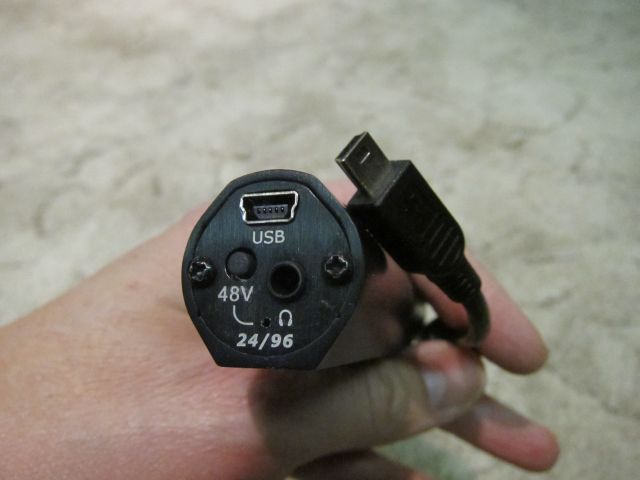
I connect my M179 to a MicPort Pro (also under $200). It's an XLR to USB preamp convertor/connector all in one tiny package. Since it's a USB device, it's more-or-less plug and play. I did have a problem with a loose mini-USB connector - but the company fixed the problem and returned it to me promptly at no cost, even though it was off its one year warranty.
MicPort Pro - Mic Input
MicPort Pro - Output to USB
MicPort Pro with XLR Mic Cable
MicPort Pro with Mini USB Cable
Audacity Screen Capture
For software, I use the free, open source Audacity. I've found the recently released 1.3.12 Beta version to be more stable and reliable than the previous version - though the previous version worked pretty well. There are a lot of tutorials and training available online for Audacity. The online help is worth your time and will save you frustration. It's also important to make sure your hardware requirements are up to snuff if you expect Audacity (or any reasonably good sound recording software) to run smoothly.
CAD M179 with pop filter
A pop filter and a mic stand later, and I had everything I needed to begin capturing and tweaking my tunes.
In the fall of 2010, I wrote a song called "Killin' Frost" more as a cathartic exercise than anything else. The song was really meant as a response to yet another person close to me dealing with a critical illness.
Here in Canada where I live, the growing season is relatively short. Farmers and gardeners alike will mark the end of the growing season by when the first "killing frost" occurs. I used that term as a metaphor for the song, ending it with a hopeful outro that repeats at the end.
I was at first hesitant to play it live. Although it has a hopeful ending, it is kind of a downer song. I recognize that a lot of audiences prefer lighter, happier fare. But I did play it for a live audience at a coffee house; the positive response was generous - and surprising. I've played it for more people since, and the response has always been generous. Folks have emailed me asking for the lyrics, implored me to include it on a CD, and asked for an MP3.
I've come to understand that the song speaks to a shared sense of the human condition. Who doesn't know someone who has fought hard against a critical illness? It's a more common experience than I wish.
So I've added the song to my playlist. You can also hear it on the player at the top right of this page. Give it a listen. I'd love to know what others think.
I doubt it's the saddest song in the world - Google reveals 265,000 results for that search string. But that's okay. I'm not sure I want to be the writer of the saddest song in the world. But hope-full-est saddest song in the world - that'd be alright.
"Small music is big!" declared presenter Paul McIntosh as he introduced Ridley Bent and his sidemen for the evening.
Ridley Bent - photo courtesy Marcel Desilets
The venue, a house concert at friends Shawn and Tony's, was filled to capacity with forty lovers and fans of intimate, live music. Just one week prior, I took in Sarah Harmer's Winnipeg concert in a venue with a 750 fan capacity. Harmer delivered a very fine concert. But for my money and from my perspective as a singer-songwriter - I much prefer the more intimate house concert setting.
Why?
At Shawn and Tony's I was able to get a front row seat (and even if I hadn't - I still would have been close). I could hear Ridley's every word (and believe me - you want to, because this guy can pen a lyric!), and I watched every lick as guitarist Chris Dunn wowed the room on his fretboard; with his eyes mostly closed, he seems to have some sort of telepathic connection to those six strings. And I don't know how he wrangled it, but co-host Tony - an accomplished player himself - played the upright bass on every song except for the one on which he played 5-string banjo (great job Tony!). The whole concert was rounded out by the super smooth pedal steel and dobro of Ken Campbell.
With only one practice under their belt in this configuration, the tight foursome needed to do little to win over the packed house. Of course - that's another thing I like about house concerts: the choir of fans is already sold on the venue and the artists. There are no tire kickers there; they're polite, attentive, and respectful. And I got to meet Ridley, Chris, and Ken in person and chat about their art.
Finally, house concerts offer gigs to artists who are enroute to larger centres, and provide small communities with a live music experience they might not get otherwise.
On the other hand, at Sarah Harmer's concert there was a steady stream of people walking past me throughout the whole show, and subsequently a steady interruption of my sight lines. And then one couple, for whatever reason, thought it would be a good idea to stand in the aisle for a time, completely blocking the sight lines of several people in my row. I get that the atmosphere is different and that fans go for different experiences; it's just not what I need to get out of a live music experience.
Woot woot! Two albums on my Xmas list for 2010 showed up under the tree this year. I'm sure there are a lot of 'must hear' albums from 2010 that singer-songwriters would especially enjoy, but for my sensibilities, these two would have to be in my top five.
These three stellar artists teamed up to cover a couple of tunes (including the superbly arranged I am a Child by Neil Young), perform each others' songs, and collaborate on a traditional tune (Wayfaring Stranger).
While the songwriting is outstanding, what strikes me most about this album are the lush solo and blended vocals, and the gorgeous arrangements. This album is produced in a way that truly allows the lyrics to stand on their own and do all the heavy lifting. The instrument and harmony vocal arrangements are all there for a single purpose - to support the songs at an emotional level.
Dear readers, you must listen to this album. Best enjoyed with high quality ear buds or head phones.
2. The Garden (Ruth Moody), Red House Records: Graceful, well thought-out discretion is the byline of Ruth Moody's first full length solo album. Moody, of Wailin' Jennys fame, expertly lays down her richly lyrical imagination and then complements it all with a variety of instruments, many of which she plays herself. This deceptively simple sounding album is the result of a seductively complex effort and subtle attention to detail. Every instrument and note serves a purpose - even an Omnichord shows up unexpectedly, but by no means frivolously.
From a performance perspective, this could be a penultimate how-to album for vocalists working to refine their delivery; Moody's tuning, breathing, and phrasing is impeccable. Every syllable, vowel, and consonant is executed with perfect nuance. Like Red Horse, this album is best enjoyed in a quiet room with excellent earbuds or headphones. Heard in this way, it sounds like Moody is sitting right next to you. Simply incredible execution.
On today's post you'll not hear form me. Instead, I'm posting some little nuggets of wisdom about songwriting that continue to inform the process for me - and are good to re-visit once in a while when I'm sliding off the song writing rails. Perhaps you will find some inspiration and encouragement from these quotes as well. Happy writing in 2011!
"The more abstract the truth you wish to teach, the more you need to seduce the senses to it." - Friedrich Nietzsche
"Songwriting is the art of blending the sounds, meaning, and rhythm of words to touch the hidden places within people." - Bill Pere
“I don’t really develop songs. I’m usually just doing something useful, like changing the oil in my car or clearing the wax out of my ears, and the song just comes to me and I just stop what I’m doing and go write it down in a little book I have for such occasions.” - Simon Joyner
"... the crafting process – distinctly different from the song generation/creation process.Creation is unconscious, spiritual, emotional, and very individual.The biggest trap that aspiring songwriters fall into is believing that when that burst of inspiration is spent, the song is "done".The successful, seasoned songwriter knows that the end of that wonderful,indescribable time of inspiration marks the beginning of the next phase in the life of a song, which is the crafting phase.This is the rational, analytical process where specific tools and techniques are applied to the raw output of the creative flow, to cut and polish the raw gem into a final product that touches people in a desired way." - Bill Pere
"But there's a thin line between songwriting and arranging" - Warren Zevon
"When you tune your guitar in a different way, it lends itself to a new way of looking at your songwriting. "- Sheryl Crow
""Songwriting is in the imagination, not always in the truth." - Vince Gill
"If songwriting is in you, it will have to come out - even if you don't make a living at it." - Rachel Thibodeau
"Try to leave people with a feeling of 'Yes, I was there, too.' - Pat Alger
Are you hoping for a favorite CD in your stocking or under the tree this year? Are you giving the gift of music to anyone on your list?
I've been pondering these questions as several of my musical friends and co-conspirators are presently recording albums or have just released albums. I'm watching with great interest as they market their albums, and wonder how they are doing at breaking through the competitive market noise. It's challenging enough to get your tracks down. Then the marketing begins.
The last time I recorded and marketed an album, cassette tapes were the preferred medium, falling bang in between the vinyl album and the CD eras (writing that down makes me feel REALLY old). There was no online presence for one's musical art back then. Me and my fellow band members sold albums strictly at performances and on the strength of recommendation. We had no distribution deal and no retailers - but also no middlemen. A reasonable per-unit price point was around a 1,000 units, so you had to ante up for significant inventory if you circulated in a small market. Still, we sold about a combined 3,000 units of two albums in max size market of about 600,000 people - and we all had full time occupations outside of music, which meant we performed only about 6-12 times a year. We were incredibly lucky to have a strong network of families and friends who sold for us commission free, and that meant we had virtually no marketing costs. We kept all of the profit margin (split five ways, mind you), and our audience was hungry for music in a way that to me, is greatly diminished today.
Fast forward: With online marketing tools like CD Baby and iTunes, do family and friends still buy blocks of albums and sell them for you? Do they want to be bothered when it's so convenient to send them online? Today, an indie artist with limited DIY skills can rack up marketing costs that never existed before: web site hosting, web site design, commissions on various distribution methods, time spent thinking up creative ads and incentives, maintaining an online presence with social media, and more.
On the other hand, the world is your market. But access to a global-sized market creates the new challenge of breaking through the clutter. And even if your market focus is regional, there is a ton of talented people doing the same thing you are, which means there is more great music to choose from than ever before. Those fantastic jam sessions shared by a few friends 25 years ago that rarely made it out of the basement are now all over cyberspace. Digital technology has done a terrific job of enabling and empowering the indie artist. There's an incredible richness of talent and variety, making the music fan's job of sourcing and sorting their favorite musical genres and preferences a huge project.
But one thing that has not changed much is word of mouth. Perhaps more than ever, music fans rely on and trust recommendations from friends. Which brings me back to your Christmas list. What indie artist whom you absolutely love will you recommend by way of a gift of music this Christmas?
On that note,I want to say a big thank you to all the readers of this little blog project. Since I began this blog in September, there have been nearly 800 page views in this little corner of my musical life, and that's a fair bit more than I ever expected. Thank you, and I wish you all a profoundly peaceful Christmas where ever you are.
*********
BTW: A friend of mine shared this story about the recent passing of Captain Beefheart, an artist with an uncompromising standard for his art, regardless of what the market said. R.I.P. Don Van Vliet.
Manitoba Hal Brolund has been an integral part of the Manitoba blues scene for a couple of decades. A fine slide guitar player for years, Hal is developing a niche for himself by specializing in blues ukulele. The hard work he puts into his craft has helped him build a fan base across Canada, and he is presently adding to that base in the Eastern USA and Europe. Hal graciously took some time out to answer a few questions many of us ponder as we decide where we next want to take our passion for crafting music.
DS: For how long have you been earning a living solely from your music?
MHB: About a decade, but it hasn't been in a solid line. I believe the reality of this career is that you work for a while at music and then take a rest, then work again at music. There are many friends of mine who manage to work all the time but there are many more who must do other things to get along. In my case I had a year and half recently where I was driving a bus for the city of Winnipeg, but that came after six years of solid touring and performing.
DS: How's it going so far? Are you making a living?
MHB: I am, but that might also be a different answer depending on who you talk to. I have no dependents and no debts, so my income can be small and still be plenty. Currently I'm getting established in a new marketplace (ed. note: Hal has recently moved to the East Coast) and I haven't been making as much here as I'd like, but that is just a matter of time.
DS: Like anyone who is self-employed, there must always be pressure to book that next gig/fill a tour, or come up with some creative way to market a new CD. Musicians have to convince the customer their art is worth getting. How do you manage the pressures?
MHB: My grandfather always told me to find a job you love and then you'll never work a day in your life. It's true that there is always something to do, either booking, writing, planning, promoting, performing, etc., but all of it falls into that category of doing what I love. The fact that there are so many different jobs to do keeps me from getting bored or lazy at one or the other. For example, on a day when I don't feel up to calling anyone or writing a grant proposal, I can work on updating my website or dig into writing new music. When I am feeling uninspired musically, there is always a phone call to make or a press release to write up about an upcoming tour.
DS: What's the music biz thing you hate doing most, and why?
MHB: For me the thing I hate to do most is booking shows. It's not that it's difficult or that I can't stand cold calling, it's the frustration of trying to get through to people when they don't know you. Imagine you book a club or venue, people are calling you all the time for shows and many of them you've never heard of. You respond to the choices that you know make sense for your venue. For a guy like me, that means that unless I have a relationship with you already, I have to work harder just to get you to take a look at me and my craft. It's the part of the business that demands determination AND a pleasant demeanor because you don't want to sound pissed off when you finally do get through to the right person to book you into a venue; it can take several phone calls over a few weeks to reach some people and they may never answer your e-mails.
DS: You seem to be a real DIY guy when it comes to the business side of your music. What have you learned to do out of necessity? I'm thinking of the whole gamut here... the tech side of recording, graphic design for albums, cold calling for tour bookings, distributing CDs, managing mailing lists, web site design and maintenance - do you do more-or-less everything yourself?
MHB: I am the chief cook and bottle washer around here. I do it all. What have I learned out of necessity? All of it. I began doing video production as a side business in the 90s and that led to graphic development for title screens, which led to web design and poster design. All of that was invaluable to me over the past 10 years as I developed websites for myself and others, did my own CD graphic layout and design (saving thousands of dollars over the years) and learning the skills of business management helps me as I plan tours and write grant requests to fund projects. It would be very difficult to get some things I do off the ground if I had to rely on paying someone for every thing that I did. I have worked with a manager to help me coordinate and plan some specific projects on a project by project basis and am in fact currently developing a relationship with a manager in Ottawa.
DS: How do you decide what to farm out and what to do yourself?
MHB: About the only job I farm out these days is publicity. It takes a lot of time and skill to ensure that journalists cover your event either by simply including it in an article or a blog or by showing up and reviewing the event after the fact. When I'm on tour I don't always have the time to spend on the phone setting up the next town's publicity and I am happy to have someone handle that for me. That way I can respond to the requests that matter where I am,. i.e. doing local radio interviews or following up on future bookings. Rather than spending my time researching each marketplace to find out who I should be contacting I develop the basic publicity of the tour (the images, the press release, the story as they call it) and then contact a publicist who knows an area well to do the forwarding to all the appropriate media outlets and follow up for any requests for interviews/features etc...
DS: What percentage of time do you spend on the business side., and what percentage on the creative music side?
MHB: Someone once said to me, "Working for yourself is great. You get to work half days. Whether it's the first 12 hours or the second 12 hours is your choice." I basically spend all my time doing all the jobs on both sides. If I were to be totally honest though, I probably spend more time on the business side than the creative side. But that is only true when I'm not working on a record. On the road to a new recording, the music takes over and I hardly get any of the business work done. It's kind of like a pendulum. It swings from side to side and sometimes there is more of one job than the other but other times it switches around.
DS: For your most recent album, Huckster (player to the right), you advance-raised the money for it by pre-selling albums using a service called Rockethub. How was that experience, and would you do it again?
MHB: The experience was fantastic! One of the challenges of making a record is the cost of recording and manufacturing. It is a huge hurdle for just about every artist I know, and just about every artist I know engages in fund-raising to some degree. Asking your fans to pre-buy a CD or donate to your work isn't a new concept, however in this age of iTunes and credit cards it's sometimes hard to get people to casually drop you $20 for a product that doesn't exist yet. Rockethub figured this out and created a site that lets you manage the fund raising. You detail your project, set up reward levels and then market the site to your fans and friends. Rockethub allows them to donate via credit card to your project with the security of knowing that should your project not receive 100% funding all the funds will be returned to the donors. This means that a stranger who likes your music but doesn't know you, can have confidence that you will complete the project and live up to the rewards or they'll get their money back. I think that is awesome and on my first project with Rockethub I received money from people I don't know, who heard about the project from others. I had sizable donations from people I haven't even performed for. It was incredible!
DS: In an age where selling single tunes for 99 cents seems to be the trend, do you think there still is a market for a whole CDs?
MHB: Even though the majority of the people are buying music online I think there still needs to be a way to deliver your music directly to fans at your shows. It all comes down to who your market is. In my case the majority of my fans are in their late 30s to 60s. A large portion of these people aren't downloading music, they are still buying CDs when they see the artist perform. Even though my downloads have gone up, more than half of them include mailing out the physical CD to them along with their purchase. There is no doubt that the volume of CD sales has fallen, though, and I think artists need to keep that in mind as they order inventory. Thankfully there are more short run options than ever before and you can get quality manufacturing in five days for 100 copies for a cost comparative to manufacturing a large run. Back in 2006 I spent $3000 ordering 1000 CDs in a digi-pack format. That got me a $3.00 cost price for resale. Now I can order 100 copies at $3.59 each for the same format. So you see, depending on the volume you'll think you can sell, you no longer need to order 1000 or more copies. The price difference isn't that much.
DS: How may true fans (those that go out of their way to see your perform and have all your CDs) would you say you have? Can you paint a composite word picture of a true fan?
MHB: Wow. That's a tough question to answer. I think there are probably many more than I am aware of. Or put another way, there are true fans in just about every town I've ever played. I hear from them as I travel and they often remind me of older recordings of mine by asking for songs I haven't played in years. I believe that the secret to success in the folk/roots world is to develop a relationship with the people that support your music. That relationship is the key to ongoing success. As for a picture of a true fan...someone who knows your music and your style, who comes to your shows and brings in others, who is there over the years time and time again, who buys your CDs and shares the music with others. (ed. note: Readers wanting to know more about this topic may want to take a peek at Seth Godin's book, Permission Marketing, Simon and Schuster. Though it was first published in 1999, the principles are still valid.)
DS: You are pretty active on various social media platforms. Is that making a significant contribution to building the Manitoba Hal community?
MHB: I hope so. I don't always know what I'm doing with the various platforms and have even considered lately dropping one or two. (I actually dropped my MySpace account earlier this year after years of maintaining it.) It comes back to relationship. I can't tour everywhere all the time. So if you are a true fan in Calgary or Vancouver and I haven't been around for a while how do you stay in the loop? So I maintain a good website, I have a Facebook page and a YouTube channel, I have a Twitter account and I have a blog on my website which is maintained as I travel with photos, music, musings etc. I hope that it helps people stay connected with me until I return to their community to perform again.
DS: You're a gifted musician and a stellar guitar guy, but you've chosen to focus on the ukulele. What's behind that passion?
MHB: Thanks Dan, for saying that. As my friend Wendel Ferguson says to me, "You really need better taste." The ukulele is my passion - that is a fact. My grandfather was (and is) a huge influence on me. He played piano (and various other instruments) in orchestras throughout Southern Manitoba. He was part of the big band era of Winnipeg when people flocked to the great dance halls and heard a great orchestra play. He gave me my first ukulele and made me promise to learn to play it. I did, and it changed my life. It opened doors that I didn't even know existed. I will always be grateful for that gift. When I play, I think of him. When an audience applauds I sometimes I think he is standing there knowing that he started me on that particular road. That sounds kind of corny, but it's true. As for choosing to focus on it, well that is more practical than you might expect. Doug Cox from the Vancouver Island Music Festival (himself a stellar slide guitar player) said to me once that there are a million middle aged white blues guys playing slide guitar. There are hardly any blues players performing on the ukulele. So that makes me much more bookable. Plus it's a whole lot easier to get on a plane with!
DS: Is your audience following you along that ukulele road?
MHB: Some are following me for sure. The core music stays the same it's just the instrument of performance that has changed. The real plus has been the growth of an international fan base though. I have definitely seen a growth in internet fans and in online orders for my ukulele work.
DS: The moniker Manitoba Hal testifies to your roots, but you've recently chosen to live in Nova Scotia. What contributed to that decision?
MHB: One of the biggest factors that makes the music business hard is the cost of living. Every week, every month without fail we need money. Winnipeg, my former base, isn't very expensive but it is more expensive than country living. As an artist I can live anywhere. After all, travel is travel and unless you're living in Toronto or New York, you gotta travel to make a living. I had the opportunity to change my life. I found a house two blocks from the Atlantic ocean that I could buy mortgage free and I was moving closer to a new marketplace for me that was expanding. It costs less to fly to Europe from Nova Scotia than from Winnipeg and the whole eastern US is now less than a day away. I have fans in Boston, New York, North Carolina that were costly to get to from Winnipeg and now they're not so far away. It made sense is what it comes down to, and I love living beside the ocean. The climate is moderate and the air is wonderful.
DS: On your latest CD, Huckster, you made a deliberate decision to record live off the floor (loopers excepted). What was behind the decision to do away with multi-tracking? Have you noticed any post production limitations to this approach?
MHB: Actually it was Art Turner that kicked off this recording style for me. In 2002 he produced a record for me called This Condition. It was a live-off-the-floor recording done over 18 hours in his studio in Winnipeg. He believed that I was a solid enough player and that my sound would benefit from less orchestration. He was right. That CD is great and the performance stands up even today. So fast forward to Huckster. I was working on the CD and had recorded about one third of the project with overdubs, bass, percussion etc., and was planning backing vocals and had even contacted some singers. In the middle of production I had to go to Cape Cod and Vermont for some shows ending in Ontario. I went down and played solo as I usually do and the audience response was huge! This got me thinking that maybe I should be making a CD that sounds and feels like a live performance. On that road trip I heard Neil Young and Daniel Lanois talking about Neil's new recording Le Noise and I was inspired, so I scrapped the earlier sessions and set up five mics and just went for it. The result is an honest reflection of what I do and it sounds live. If you listen closely you can even hear cars going by on the street outside and a raven cawing in the background. It's great.
DS: What's on the horizon that excites you right now?
MHB: I think what excites me the most right now is just getting to play more and more. Moving here freed me up to spend more time making music and making my life all about music. I've begun work on a Christmas show for next year, I have a recording idea that I'm developing with a friend from Halifax, and I am hoping to visit Germany in August 2011 to do some playing there.
DS: Thanks a lot for the interview, Hal. I wish you all the best on Huckster. Readers - and especially blues fans - you owe it to yourself to get this CD. Huckster is a great listen!
MP3 players are awesome for musicians, but if you're using yours to listen only to music, you might be missing out. There are some fine podcasts out there that can inform and inspire any musician looking to get to another level (spoiler alert: if you're already making a living off your music, this may not be for you).
Here's what I've discovered to be the cream of the crop so far (disclaimer: I have no relationship with anyone related to these programs; I've simply discovered them and found them interesting and helpful):
Music Business Radio: This podcast comes out of music city USA - Nashville - but don't go thinking its focus is only popular country music. Host David Hooper interviews guests that range from artists to label execs to publicists to... you get the picture. Each guest offers practical tips on a wide range of topics. Hooper is an excellent interviewer, and despite its plain-Jane name - Music Business Radio - its moniker makes clear what the show is about, while offering breadth and depth.
A recent episode featured great online marketing advice from exec John Clore of Sony Music The show is rich in other ways too: I discovered Hannah Miller during Dave's Demo Derby portion of the show, where the guest offers feedback on music submissions from less established artists. Periodically Hooper offers bonus content in separate, shorter podcasts that feature an artist and his/her music.
Overall, a fine blend of music, information, and inspiration.
Music Career Juice: Presented by experienced music biz guy Peter Spellman, this podcast can be a bit dry on the presentation side, but it's rich in content, and covers a lot of ground in different episodes.
Pandora Presents... the Musicology Show: This podcast is purely about the music. Host Kevin Seal brings in guests who are experts at very specific skills. What to know about song structures? The difference between a xylophone, marimba, vibraphone, and more? Want an education in percussion? Rhythm styles? Recording tips? Mixing vocals? Seal and his various guests take music apart layer by layer for listeners. If you've ever asked, "How do they do that?" about anything musical, then this is the show for you.
A Musician's Life: If you'd prefer something in smaller bites, try this five-ish minute podcast from WXPN radio hosted by Tracy Tannenbaum out of Philadelphia. I recently heard that Philly is home of the second ever folk festival after Newport in the 1960s; it's where styles of the northern and southern USA meet, blend, and fuse. A good listen in the car if your commute is short.
PRI Selected Shorts Podcast: Reading fine literature should be part of any songwriter's healthy diet, but some lifestyles have us so steadily on the move that literary indulgence is a rare treat. Reading a book while driving should never be attempted, and going for a run or a walk while trying to read can be a challenge. At once a week, this short story podcast from Public Radio International is high quality stuff read by actors who know how to tell a story to a live audience. This is a podcast I await with eager anticipation.
My astute Canadian readers will have by now observed that all of the above are American offerings. While Canada has a lot of good podcast stuff, I've found little that provides the kind of specialized content available from the above sources. I'd like to hear from you about how you nurture your musicality. Send me your favorite way to get inspiration and information - and I'll share it here - or simply add it in a comment below.
PS: Since I started this blog just a few short months ago, it has already totaled about 600 page views. A big THANK YOU to all the readers who show up here for a skim through. I hope you're finding it helpful.
This week I am reminded that some songs are born of revolution, and others of evolution. Evolution describes a song I just posted: "Who will pray for me now?"
First written in 1997, this song is based on a story about a young women with what she considered an 'inoculated' life style. She also had, perhaps, an over-simplified view of life. Her Grandmother - a deeply religious individual, prayed daily by name for each of her fifty or so grandchildren. With this spiritually prophylactic life philosophy, my protagonist felt immune to her actions... i.e. I'll do whatever I feel like because I know my Grandma is praying for me. When Granny crossed over to the other side, a dose of reality hit. Hard to believe, perhaps, but a true story.
I never was completely satisfied with the lyric, even though I had performed it many times over the years. Recently I refreshed the lyrics after reviewing my notes on it from work-shopping the tune at the Manitoba Independent Song Circle and and the Winnipeg Folk Festival Retreat. After some reflection, I slashed an entire verse, re-ordered some other verses, and tweaked a few lines in the first two verses. This new and improved version feels a lot tighter.
The evolution of this tune has been a great process, if a long one. I invite you to give it a listen on the player at the top right of this blog post, or here, and comment on the song.
Finally I'll repeat a theme from another post: If you don't have song-writing informed friends who can be constructively honest with you about your songs, I highly recommend finding a few friendly critics and mentors. There's not a song I've written that hasn't been improved by some helpful critique from some really smart folks in my circles.
Keeping an audience engaged for one or more 30 minute sets of live music is a much bigger challenge for a solo artist than it is for a band (unless, of course, said band has not worked on their arranging skills).
Having been part of a few bands over the decades, I always found it easier to blend my creativity with others to develop a rich sound. In a band, you have loads of potential with other instruments, players, vocalists - and ideas. (Though bands can get into predictable ruts, or overlook obvious arranging mistakes - but that's another post).
Unless you are a talented instrumentalist and vocalist adept at using loopers, your tools for keeping up audience interest are fewer as a solo performer. Here are some antidotes to common mistakes, some more obvious than others, that I've seen performers make (yours truly included). Follow these tips to help keep audience interest up over the long haul:
Choose a song order that varies the time signature and speed. Intersperse slow songs with faster ones, louder tunes with softer ones, sad themes with uplifting themes. Making sure you have some contrast built into your sets will offer something for everyone.Tossing in an instrumental tune here and there can help vary a set, too.
Make sure to build some contrast into your individual tunes, too. Even the most basic players can start a song simply and quietly and build it up from there. Consider opening with just a few notes from each chord, and then building into a full chord accompaniment, then bringing your audience down again toward the end of the tune. Whatever you do, avoid playing full out, all the time, at max volume. With all but the most gracious and attentive audiences, you'll soon find yourself in a shouting match with listeners who would rather visit than listen.
Match your playing to the mood of the song, to the lifts and dips in the lyric. Allow your voice and instrument to bring real emotion to the lyrics. And offer more contrast than you think you need. In my experience, the contrast I hear from myself is several degrees greater than what the audience detects. Nuance can be used to great effect - but it can also be so subtle to the average listener that it goes undetected.
An appropriately placed but unpredictable pause in a song can make a fidgety audience focus in a way that only silence can. It's a handy tool, but use it sparingly and well.
More advanced performers can vary their playing style. As a guitarist, I like to switch between rhythm, finger-style, flat-picking, and different guitar tunings, choosing what fits the song best. Audiences really appreciate variety.
If you can play more than one instrument competently, work a song or two into your set! You don't need top be a virtuoso on a second or third instrument to be appreciated by your audience.
Enunciate!! Whether it's your lyrics or your between-song intros, enunciate your lyrics and speak clearly and slowly between songs. Sound systems and room conditions can create echoes that can make you nearly impossible to understand. All the best performers I've seen are very intentional and deliberate about this. You've put a lot of effort into writing your lyrics, now make sure people can hear them.
Balance. Keep a close ear on your instrument volume relative to your vocal volume. Sound system biases aside, some (even experienced) performers play their instrument so loudly all one can hear is a competition between lyrics and accompaniment.
It's about more than just the music. Audiences like to get to you know you as a person. Share something of yourself with them, share the story that led to the song, engage them in any little interesting story about something unique that happened that day or week. But do keep it concise and brief. Unless you are very experienced, practice your mini-monologues ahead of time. Folks who consider themselves to be great ad-libbers can babble on at length and bore their audience to tears. Use your lyric writing skills to develop clever banter or inspirational insight between songs - but make sure you keep it shorter than the song itself. I've been to live concerts of big name artists who barely spoke a word between songs. They seem to forget that I can hear their music on a recording. I paid a decent ticket price and came to your live performance for more than that.
Be careful with humour, whether it's in a lyric or your in-between song banter. Humour is a tricky device that requires a combination of skills best left to practiced artists. But that doesn't mean you can't be funny. Some of my favourite shows featured performers who, by simply, sincerely, and authentically being themselves, were spontaneously funny.
Be yourself, but not the self you allow yourself to be among your closest family and friends. They know you in context, and will more easily overlook your quirks and jokes (nudge nudge, wink wink) than perfect strangers who may be meeting you for the first time.
Finally, try as best you can to know your audience. Knowing your demographic will help you choose songs and interact with your audience in genuine ways.
There's a lot to concentrate on as a solo artist. In a band, you can hide behind other players and instruments; when you goof up, it's not always so noticeable. As a solo artist, you're fully exposed (no pun intended) and need to pay attention to a lot of detail. It's a challenge - but there are a good many who have perfected a style and presentation that can blow your socks off. And when you get it right, the satisfaction is extremely rewarding!
This week I got together with a friend in his studio to lay down foundation tracks for a couple of new tunes I've written. While we had a lot of fun, it was a helpful reminder once again to focus hard on tempo when you rehearse.
I play to a click track when I record at home on my own gear. It's a necessary discipline if you want to add tracks featuring you or other performers later on in the process; you and they will need a rock solid tempo to play to, and won't be able to anticipate a tempo that moves around. (For readers not familiar with the term, a click track is a little automated metronome you hear in your headphones when you record to keep your tempo steady.)
Kelly, my recording engineer, insists artists play to a click track when recording. This critical step can save a lot of time and frustration later on when you're laying down other additional tracks. Kelly says that an artist's willingness to lay down a click track at the outset separates the pro from the amateur. He's worked with too many performers who claim their timing is rock solid, but who are quickly found out when a click track is added (or percussion, instrument tracks, or additional vocals are added later on.) A pro's timing will be dead on with a click track, says Kelly; these folks can lay down repeated takes to a beat that seldom wavers.
It's a good discipline to rehearse frequently to a metronome or some other automated, unwavering timing device that keeps your rhythm on beat throughout a song. If you are are easily frustrated in doing so, keep at it until you perfect it. It'll pay off if you ever play with others or do some recording. And your engineer and fellow musicians will appreciate it, too.
"Write what you know" is about the most common advice a song writer can receive. It also happens to be the best advice one can take if you want to write songs that move people.
That's not to say great songs can't be written about all kinds of topics that one does not experience first hand. Rather, I think the trick is to spent some imagination time injecting yourself into a given situation so that your emotions about it come through with authenticity. James Keelaghan writes great songs about Canadian history. He manages to inject himself into the story in a way that makes its characters come alive. He seems to live inside the story and its characters for a while, then puts pen to paper and fingers to strings.
If you're unable to do that effectively, keep trying. In my experience, great songs come from living with the story for a while. Subconsciously, my imagination is always brewing up lines that at that time see to come out of nowhere and have no home at the moment. If that happens to you, jot them down. Many writers are collectors of words, phrases, fresh metaphors, and ideas. Much later - sometimes years later - these are pieced together into a brilliantly quilted song. Finally, don't be afraid to throw out a day's work in words. In a documentary by Lian Lunson, Leonard Cohen says,“You have to write down what you have to abandon. You’ve got to see how it works with the whole thing and then throw it away.”
But don't throw it away physically just because it doesn't have a home in particular song. It may well find a home in another project down the road..
On a related theme, last week I performed two new pieces at the Winnipeg Folk Exchange. I expected the tune "No Going Back Can Bring You To Me Now" would go over well. Our foursome had developed a heart-rending arrangement of this break-up song (can there be a more popular theme?) - and the audience did love it. But to my surprise, the song before that ("Killin' Frost") generated more post-performance feedback than I had expected, for a song about critical illness and dying. (Both songs can be found here.)
A minister friend requested the lyrics, and told me he quoted from it three times the next day as he met with people in uncertain health situations. I also received a request from a university student to quote from for a paper she is writing on dying. And in less than a week, a live performance video of the song received 26 views - despite less than ideal audio quality. Who'd of thought a song so weighty would be so well received?
I was anxious that writing about such a heavy topic from a second hand perspective wouldn't seem authentic. But the from the feedback I've received so far, it seems I've written something that resonates with listeners. To me, that's an indication of authenticity in song writing. A rough count immediately brings to mind over a dozen people I personally know who have died from, survived, or are currently living with a life threatening illness - some for the second time. Living with such an uncertain future for yourself or someone dear to you is such a common experience, despite the fact that we all just want it to go away.
While I'm grateful for my good health, it didn't take a huge leap to myself in their shoes - and then capture what it must feel like in a song. So - go forth and write what you know! Whether it's joy or sorrow or humourous or love - it'll shine through in your song when you allow yourself to be vulnerable.
Disclaimer: This post is simply a reflection on my 20 year journey as a songwriter. In no way should it be construed as advice from a professional song writer on how to write a marketable song
Movember is a brand new 13th month added the the calendar that has men the world over growing stylish moustaches for the cause of prostate cancer research. Why Movember? Because in a parallel universe, it occurs at the same time as November. And, participants get to be two-faced for a good cause!
In addition to donating my face to the cause (hint, hint - give here, and yes, I became clean shaven in time for Nov. 1 and am presently working on my Grow n' Show status), I have written a song in honour of all those who have ever spent time in that nether-land between knowing you may have a life-threatening illness, but waiting for a confirmed diagnosis and/or treatment. We have all experienced those stuck-in between places of uncertainty at various levels, but I have a special place in my heart for those courageous souls who live there for while, and do so with grace and aplomb.
This is probably about the best advice I've ever received when it comes to songwriting. The gift of it comes from David Francey, with whom I had the absolute pleasure to spend some time with about 18 months ago. He patiently listened to some of my tunes, complimented my guitar playing, and helped me focus a few lines that weren't quite there yet.
A multi-Juno award winner, Francey was songwriter in residence at Manitoba Music, which is where I had the pleasure of meeting him - and later enjoying an intimate live performance by him and his excellent accompanying guitarist (my apologies - I've forgotten your name). With maybe just 30 people in the audience, David regaled his listeners with the birthing stories of some of his songs, and straightforward answers to questions only songwriters would ask. What an evening.
But back to not trying to be profound. I've taken David's advice to heart. and it really seems to be working. Lately I've been giving my muse more creative freedom to stop and start on its own rather than trying to force it into life. Sometimes that means an entire song spills itself onto a page; other times it means simply jotting down a concept for a song and leaving it at that. And on some days, just writing one great line and moving on to other non-writing tasks is equally satisfying. And the corollary to this practice is this: never be afraid to toss out a great line or two if it no longer fits where the songs is going. Words and lines are like pieces of a universal puzzle. Save 'em. If they're good, they'll find a home in another song.
I believe what David was trying to say is to trust one's muse. It can mean a lot of starts and stops. It can mean intense hours of creatively driven energy. When you feel it coming on, don't set it aside - you'll write better, sleep better, live better. And when the flow stops, set it aside - don't flog it, or you'll risk losing interest and killing the piece. Finally, allow yourself to feel good about whatever you've accomplished, whether it's a great three word idea or an entire verse or song. Feel satisfied, move on, come back to it later. (example: I thought I had finished writing a song called "Killin' Frost" some weeks ago. I put it on the shelf, came back to it last week with a clearer head, and the klinkers I was ready to live with a few weeks ago jumped out and nearly took my head off. I tossed out several full verses, wrote one new one, and changed up the melody on the last verse. Ahhhh.... now that's better!)
David's advice has gotten me out of a lot of songwriting log jams lately. As a result of not forcing it - not 'trying to be profound' - I think my work has improved remarkably - but listeners will be the ultimate judge of that. And you'll have exactly that chance if you're in the Winnipeg area on Thursday, Nov. 4. Come on down to the Folk Exchange, 211 Bannatyne (doors at 7 pm) and hear six singer-songwriters - myself included - share the stage and perform their original work just for you. And, I'll be bringing along three very talented people to back me up on a brand new arrangement for a brand new tune. If you like it, perhaps it will show up on my online player soon.
And, if you ever have the chance to chat about song writing with David, don't miss it. He's a real salt-of-the-earth kinda' guy, full of great advice about melody and lyric composition - two art forms he brings together so seamlessly they can't again be separated.
- dan silas
PS: David's Road Journal blog is a great place to learn about gig venues all over - where they are, what the audiences are like, and more. And it must be great to hang out with so many inspiring co-conspirators in music... which brings me to another piece of advice. Never stop listening to music. Lots of it. It is its own eco-system, feeding itself in a never ending cycle of absorption, evaporation, and precipitation.
In Part 1 of this post I pointed to a few of my new favorite Canadian singer-songwriters. Now to south of the 49th parallel... and beyond.
Some months back I subscribed to some NPR music podcasts, from which I draw my sources for this post. But first, you need to know about Danny Schmidt.
A Floridian friend of mine who currently lives and works in China put me on to Danny. Danny comes out of the Austin, Texas music scene - long known as a hotbed of really fine songwriters who consistently resonate to my polarity. Geographically, hearing about Danny from Florida via China to Canada is a long way, but in cyberspace it's no surprise for the word to travel.
Danny's one of my absolutely favourite songwriters of this decade. With melodies that unfailingly complement his layered lyrics, Danny's songs stand up well to repeated listening. You can wallow again and again in this guy's metaphors. His descriptive analogies feature a beautiful simplicity. Danny has a natural gift for the songwriter's "show me, don't tell me" mantra.
I met Danny in person at a recent concert. He said people call his lyrics complex; I'd call them rich stories. Danny can turn a phrase that will twist your heart and make you smile at the same time. If you Google Danny, you'll find all kinds poetic comparisons to other artists - but I won't repeat them here. I believe Danny thinks everything in pictures - perhaps that's why he also has a great eye with a camera. This guy's an original artist musically and visually - the real deal. Check him out.
Now, on to musicians and songwriters I'd recommend via NPR - some with an already sizable profile:
The Swell Season: Glen Hansard and Marketa Irglova are the powerhouse pair behind a band that have featured a bunch of excellent musicians. The amazing thing about this European pair is that I don't need to hear all the lyrics (though I want to). It's their melodies, arrangements, and soaring vocal contrasts that capture my ear and heart. Listening to Swell Season with my eyes closed takes me away to another place that is helpfully far away from whatever is on my mind at the moment. They are simply captivating.
Ben Sollee and Daniel Martin Moore: Strong lyrical hooks in the first line of this pair's songs will suck you in immediately and take you for a terrifically rhythmic ride on their percussive, harmony laden roller coaster. Give these guys from Kentucky a listen. It's worth it.
Jim James: Perhaps more famously known by the My Morning Jacket moniker, I may be among the more unusual fans who would rather enjoy Jim James solo. With amazing vocal range, each of James' songs is infused with passion many artists lose after having performed as much as he has. I especially enjoy him with sparse accompaniment, and in particular when he strums the much maligned Omni-chord, a digital Suzuki instrument (now called the Q-Chord). James has an amazing capacity to re-invent his songs over and over again by refreshing their arrangements. That's the kind of variety I can love. Instead of the usual artist web site link, I've provided a YouTube video link to the Jim James peace that drew me into finding out more about him.
There are many more great singer-songwriters to be discovered in cyber-space. It just takes some patience and time to find them if you're not in the direct word-of-mouth or concert loop.
Marcel Desilets is a Winnipeg-based singer-songwriter whose music goes best with a hot coffee on a sunny, Saturday morning patio. About to release not one, but two albums simultaneously, provided a great opportunity to dig a little deeper into Marcel's music.
DS: How long have you been playing and writing?
MD: I started playing sometime when I was around 15 years old, writing just happened naturally at the same time. (Ed: I estimate that's about 25-ish years or more)
DS: That's young. Most 15 year-olds are learning covers. Which artists are your greatest influences?
MD: Well, it almost sounds cliché, but I guess but my main influences, especially early on, were Neil Young, Bruce Cockburn and Bob Dylan. Neil Young’s “After the Gold Rush” was the first record that made me really stop and listen.
DS: What in general, inspires your songwriting?
MD: “This is a true story” is an intro to one of my more humourous songs. But all my songs are essentially that: they’re all true stories. I mostly write from personal experiences, from what is around me, close to me, and everyday simple occurrences.
DS: Do you approach songwriting as a discipline, as in 'I must write every day' or as the muse appeals?
MD: I’m pretty undisciplined when it comes to writing, although I always have a pen and paper of some sort with me to write down phrases that come to mind, even sometimes just a word or too. Then, when the moment of inspiration strikes where a series of lines may present themselves, I have notes to search through to look for connections that may help in the building of the written portion of the song.
I’m always noodling around on the guitar, much more than noodling with the written word, so a lot of my songs come from a picking pattern that I’m just fooling around with, or a chord progression that just all of a sudden sits differently with me, and coupling that with some lyric or even just a melody that runs through my head is where a lot of my songs are born.
Dreams too. I have several songs that were direct results of lines that were written down upon waking up from a dream state with that “I better write this down right now” feeling.
DS: Ah – a collector of words and phrases. I can identify with that. What do you most want to say in your songs? How do you want people to feel after listening to your music?
MD: I don’t think I write with the intent of putting a message in my songs. I just write whatever comes to me at the time. The song has to sit well with me, and mean something to me.
I’ve heard time and time again that my music leaves people feeling good. That’s a huge and humbling compliment. I have written some songs that have a sense of longing and loss (although the metaphors can certainly be interpreted differently) but I don’t typically write sad songs. As much as I like hearing them, I leave the writing of sad songs to those who do it well. A good friend once called me “militantly happy.: I live a life that I’m very thankful for, so my songs come from that.
DS: You are a DIY music maker. Describe Dragonfly Studios (your home studio set up). What is your essential gear, and how did you learn to use it?
MD: I'm not a gear head. Recording myself was really something that I never wanted to delve into, but reality and finances dictated direction. I was incredibly fortunate to have had a capable computer given to me which became the foundation of my home studio, and turn what I thought would be a huge learning curve and detriment to creativity into exactly the opposite, I’ve now recorded three full length albums in my studio.
My set up is very simple, which works for me…a couple decent mics, interface, and the desire and drive to make it sound the best that I can. My music has a simple structure to it, so the simple recording set up works well.
DS: You are a multi-instrumentalist. What instruments to you play? What was the first instrument you learned to play?
MD: My first instrument was the acoustic guitar, one that my dad bought from a friend of his for ten bucks. I remember we painted it red and black. I eventually picked up the electric guitar and went back and forth a lot between the two. Over the years I’ve learned to dabble with a few other stringed instruments including mandolin, banjo, Dobro and other acoustic lap slides, and electric lap steel guitar. I also play a little harmonica, an instrument that my dad was exceptionally good at.
DS: From what I know about you, I'd say you're very humble to use the word “dabble.” You're increasingly being called upon as a sideman. How did those opportunities come your way?
MD: I started the sideman thing with my friend Brenda Neiles. Mostly I was playing banjo with her on her songs, and one day when we were practicing I asked her, “Have you ever seen that old guitar of my Dad’s?” I was referring to the Dobro that belonged to my dad which I had inherited when he passed away. I hadn’t ever played it much but took it out of the case and from that day on really started to play it. That’s the instrument that I’m now called to play mostly when asked by other performers for accompaniment.
DS: Congratulations on the two new albums you're about to release. One has lyrical material, one has instrumental material. Can fans expect more of the same as your past work, or is this something quite different?
MD: The songwriter album, titled There’s a Story To Tell, features eleven tunes, one of which is an instrumental, with the instrumentation arrangements that I am familiar with, and love to work with. The structure of my songs lends itself to traditional style instrumentation.
I’m once again privileged to have good friends from the Winnipeg music scene accompanying me on this record both instrumentally and vocally, including: Anthony Kost (upright bass), Jed Desilets (drums) and Johnny Calderon (electric bass) from the Bokononists, Kami Desilets (harmonies), Vanessa Kuzina (harmonies), Allison de Groot (banjo) and Rosalyn Dennett (fiddle) from Oh My Darling, Jonathon Alexiuk (trumpets and saxophones), and Lindsay Jane (harmonies). I’ve also added lap slide guitar here and there. There are some tunes though, that fall out of the “folk” category somewhat, bringing a bit of a different direction to parts of this album.
Two Minute Warning is a project that developed around all the little ideas I come up with while sitting with the guitar or banjo, ideas that don’t necessarily find their place in songs, that I started thinking would be fun to catalogue. It evolved into the idea of creating a full album of tunes, none of which are greater than two minutes. It was a fun challenge, that allowed me to play all the parts with the instruments I love to play, including of course guitars, as well as banjos, lap slide instruments including Dobro, acoustic lap slides, slide banjo and electric lap steel, also electric fretless bass, mandolin and even ukulele. There is the occasional shaker and even an old suitcase I used for some percussion here and there.
DS: You've already sent me some sneak previews from Two Minute Warning. While I lean more toward lyrical music, these samples drew me in immediately, and made me smile. What are your hopes for the instrumental album?
MD: The main objective in my music is always to create for myself first, and to be totally satisfied creatively with what I set out to accomplish. Part of the creativity with Two Minute Warning was the challenge of creating a flow, or continuity, being that these pieces were all short pieces that vary in length and in style. I wanted this first and foremost to be an album of music that could be listened to and enjoyed in its entirety.
Having said that, I do believe that a lot of what’s on this album are the type of pieces that could be used in theatre, or as segment breaks you might hear on talk radio. So if anything, I feel that this is probably my most marketable work to date, and I couldn’t help but think along those lines as I was putting this album together.
DS: I'm a big believer in testing new material with others – kind of like a quest for the best I can do. You belong to the Manitoba Songwriters' Circle where you receive critique and feedback on your new material from fellow singer-songwriters. How has this experience helped you improve your craft? What advice might you have for budding singer/songwriters about to go to their first song circle?
MD: Aside from meeting so many great songwriters and developing good friendships, the circle has been a good experience all around for me. Having the opportunity to hear feedback that comes from so many different types of backgrounds, and from all kinds of perspectives such as melody, rhythm, structure, and the craft of song writing, has given me much to ponder when the inspiration for a song hits me.
For first time attendees, I’d suggest going with a thick skin, and the understanding that all suggestions/critiques are given with the intent that you can take it or leave it, in terms of what you feel is right for your song.
DS: When and where is your double CD release concert? How can people get tickets?
MD: The CD Release Concert will be held on November 6, 2010 at the Park Theatre, 698 Osborne Street, 204-478-7275, Winnipeg MB. Tickets can be purchased through me for $10, or for $12 at the Park. The line up of musicians backing me for my set is still in progress, but I hope to have most of those who played on the album joining me on stage.. but it’s looking good. Opening the evening with a set will be the fabulous Lindsay Jane!
DS: Thanks for taking the time to do this, Marcel. All the best on your new projects. I'm looking forward to hearing your new CDs.